Step Four: Fostering Effective Communication With Donors

Step Four: Fostering Effective Communication with Donors

In steps 2 and 3, we talked about cultivating relationships and building connections with prospective donors. Unfortunately, all of this can quickly fall apart if effective communication isn’t established. Step 4 is focused on donor communication and how implementing strong communication in your process can improve commitment and motivate individuals to consider making a major or planned gift by showing them both the immediate and long-term impacts.

What’s the best way to communicate with donors?

When deciding whether to donate, people primarily make their decision to support a campaign based on the person who is soliciting their support. Others will judge the campaign’s worthiness based on the contents of campaign communications materials and activities. As such, you should draw up various campaign materials that help you properly communicate with donors. Below, we list a variety of documents that keep your target audiences updated about any new developments.

  •  The Case for Support

If you’ve never heard of a Case for Support, you’re not alone. While brochures and websites are fairly common, fewer people have heard of a Case for Support unless they’ve worked in this space previously. Let’s jump into an explanation, so you can truly understand why it’s so essential that your organization has one. The Case for Support is a living document that tells the reader the story about your organization, why it exists, and who it serves. It is built around the framework of your vision, mission, and need.

  • Strategic Plan

The Strategic Plan addresses the direction for the organization based on the feedback from stakeholders. It is a critical document and allows stakeholders the opportunity to share and discuss the strengths, opportunities, threats, and weaknesses. This keeps everyone on the same page.

  • Fundraising program website

A fundraising website is a starting point for communication. Today, it’s arguably the first place that anyone would go to learn about your organization and provides countless avenues for you to connect with prospective donors. If you want to create an email

  • Letters

Donation letters are a common tool that charities use to entice prospective supports to donate. These don’t often have the depth that a typical brochure would. Instead, they’re short and address a specific need that your organization is trying to meet. They also typically include a written ask for a donation.

  • Brochures

We’ve all been handed brochures at one time or another. These are short and sweet ways to walk us through any given topic. They take your cause and break it down into a condensed format that any prospective donor can easily understand.

  •  Proposals

These materials help to explain your fundraising program to your donor and encourage their investment in your charity’s cause through a major or planned gift. Don’t write a proposal unless your donor asks for one. Develop a proposal together!

Final thoughts
You may be thinking, “What about a simple phone call or email?” and yes, those do have a time and place in donor conversations as well. However, the communication methods we listed above are common effective ways that you can put your best foot forward with prospects and come out of the interaction successfully. For more on Step 4 (or any of the 7), check out the 7 Step Power Donor Solution.

Happy Fundraising.

Step 3: Connecting

Family Day… Remember, You Can’t do it Alone.
It Helps to Have Connections.

Why every charity needs a Godfather or Fairy-Godmother 

Engaging stakeholders has long been a struggle for charitable organizations. This is a core element of charity marketing, and yet, it’s hard to even start the conversation. How do you discuss estate and philanthropic planning? How do you break the ice and make planned giving an easily understood and explained topic? This is where “connectors” come in. Connectors are individuals who build bridges to prospects. In this blog, we’ll learn why every charity needs these connectors, or ambassadors, to act as lifelines to funding. Let’s get started.

Who are connectors?

In some way, connectors have created an association or formed a charity and your prospects. These links produce the potential for prospects to be influenced into donating to your charitable organization. Connectors can identify individuals who may be promising prospects. They can make introductions to people who can help you network with prospects. Or perhaps they can be part of the cultivation or solicitation process itself. A good connector can wear many different hats as a donor, volunteer, employee, or other individuals that a board member knows personally.

How do we use connectors to our advantage?

When you initially think about connectors, you may consider people you already work with, namely those on your Leadership Committee. However, connectors can be anyone, and the more connectors you identify the better! Think of connectors as an army of individuals working on your behalf to expand your fundraising efforts. If you only have a connector or two working to raise funds, it will be difficult. If you have hundreds, the load lifts significantly.

Who can we consider connectors?

As noted above, a connector can be anyone. Here’s a shortlist of who may be a connector for your organization. This can help you as you begin to brainstorm.

  • Donors 
  • Volunteers
  • Employees
  • Professional advisors (financial or legal)
  • Outside individuals known personally by the board member
  • Leadership Committee members

Your leadership committee members are particularly important to this process. To help set up your charitable organization for success, identify and enlist individuals who canjoin the fundraising team for your Leadership Committee. Ideally, these individuals would fit at least one of the following criteria.

1. A passion for your cause
2. A willingness to donate a major gift
3. A meaningful connection to your charity’s prospects

Engage this team as you seek funding. They are a resource to you and utilizing them throughout your fundraising program. As they are passionate enough about your cause that they see the value in donating themselves, they will be more successful in discussing your mission with prospects and other connectors, which in turn, results in major and planned gifts.

Additionally, it’s essential to consider financial and legal advisors as key connectors. They also offer a unique business building opportunity. When they have discussions with clients regarding charitable giving, they can present a variety of choices. As a trusted individual in that scenario, they serve as a key networking resource. Without them, you may never connect with certain individuals. With their support, your ability to reach and engage an entire community is vastly expanded.

Final thoughts

Don’t wait for donations to fall from the sky! Use your charity’s connectors to help build the connections you need to be successful. For more information, read about the 7 Step Power Donor Solution. You can also visit FUNDING matters here.

Happy Fundraising.

Valentines Day

💝💝💝 … Better Than a Box of Chocolates!

Forrest Gump is known for the famous quote, “My mom always said life was like a box of chocolates. You never know what you’re gonna get.”

And in general, this sentiment holds true…especially when it comes to charitable funding. Charitable organizations work long and hard to foster relationships with potential donors, set up conversations, work in their ice breakers, and maybe (MAYBE!) get a donation. 

But FUNDING matters wants to help. We’ve developed our GIFTABULATOR app with this particular dilemma in mind, and we’d argue that it’s better than a box of chocolates for your organization this Valentine’s Day (don’t tell your sweetheart!). Keep reading to learn more about this interactive and intuitive tool.

What is GIFTABULATOR?

Each year, roughly $21.8 billion (an average of $142/person) is spent on Valentine’s Day each year…imagine if that went to charitable giving. This phenomenon illustrates something crucial. Although consumers are willing to spend money, they’re not always clear on their financial goals. They spend money on Valentine’s Day and forego charitable giving that can aid their community for years to come. If your charitable organization is seeking donations, it’s up to you to help donors understand how they can make it work financially. This will be the tipping point that takes them from “donating to charity is nice” to “donating to charity is part of my budget.”

Fortunately, FUNDING matters has a solution for you. GIFTABULATOR is an app for charities, donors, advisors, etc. to illustrate the best ways for individuals to give to charity and to make a positive difference in their communities while decreasing their taxable capital gains either now or in their estates. In short, it’s an easy way to help your donors understand their financial goals while giving back to their community.

What can GIFTABULATOR demonstrate?

Individuals need to see the real impact of effective estate planning, charitable giving and tax minimization. Without a tool to do this, the idea of giving pre-tax dollars is just an abstract idea…spending money on Valentine’s Day chocolate seems more fulfilling. 

Now, you have the power to show donors:

  • How they can best support your charity without impacting their lifestyle
  • How a donation to your charity can minimize their taxes and those of their beneficiaries
  • How they can ensure that their values and beliefs are reflected in their estate planning choices
  • How their potential to give back is based on their assets as opposed to their income

While it’s easy for many to think that they don’t have the means to donate to philanthropic causes, it’s simply not true. Both your donors and clients can be in control of their financial future, pay less tax, and do some good along the way.

Interested in trying it out?

The GIFTABULATOR helps your donors show you love while maximizing their own financial situation. You can read more about this here: GIFTABULATOR – Maximize Your Donor Gifts Today.

If you want to try out GIFTABULATOR for yourself, see the impact of your donation here. There’s no software to download!

Happy fundraising.

How To Find Your Next Big Donor

How to find your next big donor

In How to Successfully Brainstorm While Social Distancing, we discussed how charitable organizations must start the process of identifying, cultivating, and soliciting high net-worth donors for major and planned giving. We talked about how you can put together a remote brainstorming session even in these difficult times. Yet, as you’re following these steps and putting together a group of individuals, you may still be scratching your head and asking, “What exactly am I brainstorming about?”

Your brainstorming efforts all come back to your donors. It’s up to you to connect your charity’s mission, vision, and goals with a prospective donor’s values, interests, and priorities. This is what ultimately results in major and planned giving. In this blog, we’ll discuss the process of prospect research and identification.

Let’s get started.

1. Do research on past and current donors

If you’re not sure where to begin, the first step is simple. Take a look at your charity’s current annual donors and find all those that have a consistent track record of giving over the last five years or more. Take these names and put them on your “prospect list.” Then, do additional research to determine which of these donors may have a high net worth and be a potential “big donor.” Once you’re narrowed down your prospects list, consider setting a meeting with a few of these candidates. This can help spark interest in becoming involved in your charity – either financially or through leadership. You never know the power a simple conversation can have!

2. Build relationships with advisors in your community

Only 60% of adults have current wills and only 4% of those with a current will have bequests. Use this knowledge to your advantage and start working with the advisors who facilitate these arrangements in your community (lawyers, accountants, and financial advisors). They can help create a fruitful situation for all. During estate planning, legal and financial advisors can recommend organizations like yours to help their clients leave a lasting legacy. By building relationships with these advisors in your community, you automatically connect with prospective donors who can contribute major gifts through planned giving. Thinking about your own charitable bequests? Read Family Discussions – Don’t Wait Until It’s Too Late.

3. Screen all stakeholders for major gift potential

Stakeholders are individuals or groups that are affected by or can influence decisions or actions by your charitable organization. They include partners, governments, clients, members of the community, funders (corporations and foundations), suppliers, employees, employee families, volunteers, and volunteer families. If you’re looking for ways to bolster your prospect list, then evaluating your stakeholders, researching their net worth, and determining their gift-giving potential is a solid strategy. Just because someone hasn’t donated in the past doesn’t mean they won’t donate in the future. A stakeholder already has a relationship with your organization and sometimes all you need to do is facilitate the giving.

Final thoughts

Building up your list of prospective donors and knowing who to reach out to informs the next several steps of the 7 Step Power Donor Solution. This is a crucial step and getting it right will set you up for future success. For more information, visit FUNDING matters.

Happy Fundraising.

Step One: Brainstorming

How to Successfully Brainstorm While Social Distancing

Nearly every facet of life has changed due to COVID-19, and that’s frightening when it comes to major charitable giving and donations. We know that 99% of current charitable donations comes in the form of cash or non-asset gifts and 20% of a charity’s annual revenue should come from major and planned gifts. And yet, giving doesn’t just happen, you must make it happen. A strategic plan must be in place and long-term donors must be cultivated. Is that possible while social distancing?

The short answer is YES. To secure major and planned gifts, your charitable organization must start the process by identifying, cultivating, and soliciting the high net-worth donors for both major charitable and planned giving. This is most often started with a brainstorming session. However, because in-person meetings are not yet safe, you’ll have to adapt it to an online forum. Virtual brainstorming is an ideal way to pursue the cultivation of donors and sustain your charitable organization. Here’s what you should know.

Does Virtual Brainstorming Work?

  1. Virtual brainstorming eliminates production blocking

    In a typical in-person brainstorming session, there is often a dominant participant(s) who tends to talk too much. They take over the session, and this hinders the creativity of the group at large. Fortunately, virtual brainstorming allows you to limit or expand group size, open the meeting to participants who are in different regions, and use breakouts within the larger session to help resolve any production blocking you may experience. 

     
  2. Virtual brainstorming enables feelings of anonymity

    Because ideas cannot be attributed to a specific person in virtual brainstorming, participants will be more likely to give you all of their ideas. It will reduce the apprehension that accompanies being evaluated by their peers for an idea that they propose.
     
  3. Virtual brainstorming increases the diversity of ideas
    When you’re brainstorming in-person, your ideas are more likely to align and conform to theirs. According to the HBR article, “exposure to their ideas causes uniformity and regression to the mean: the most creative people will descend to the level of the group average.” Virtual brainstorming encourages participants to offer a wider variety of ideas because they have space and time to do so. While you ultimately come together and share your ideas, you’re not engaging in crowdsourced creativity, which can stunt progress. 

Create a Virtual Brainstorming Session For Your Fundraising

A brainstorming & strategy session helps you understand your WHY and PURPOSE behind funding your charitable organization. The outcome will enable you to establish the scope, timeline, and goals of your fundraising program. Here are some tips that can help you put together a virtual brainstorming session to maximize major charitable giving, donations, and planning giving. 

  • Consider the roles and expertise you want to be involved in the session
     

Most people will try to create a virtual brainstorming session by making a list of the specific participants they want on the call. Instead, work backward and decide the roles and expertise you want on the call. Then, figure out who you know who fits that profile. This way, you’ll know you’re bringing a diverse range of backgrounds and perspectives to the table. 

  • Take advantage of being remote

Sometimes scheduling a call with everyone’s remote schedules and time zones can be a real pain. If you don’t think you’ll have more than 30 to 60 minutes together virtually, then ask your team to prepare in advance. This will actively help combat “groupthink” and allow you to come up with more ideas. Ask everyone to come up with 5-10 ideas on their own and send them to you in advance. Then, you can compile them in a shared document for everyone to look at during the call. 

  • Use your time together to get specific 

When you talk about a problem at a distance, you’re more likely to think about it in the abstract. This can make it difficult for people to respond and build on generic ideas. After everyone has come up with their own list of ideas, come together and get as specific as possible. You can do this during a conference call or Zoom meeting. 

Final thoughts

The global pandemic doesn’t have to slow down your fundraising efforts. You can still receive donations, planned gifts, or other major charitable giving. Brainstorming – virtual or in-person – is just the first step of seven in FUNDING matters’ Power Donor Experience. To read more, see the 7 Step Power Donor Solution or The Ikea-Inspired Guide to Fundraising.  
Happy fundraising.

Power Donor Experience Design

Mark Twain once mused, “I’m in favor of progress; it’s just change I don’t like.”

Covid and the pandemic has caused a disruption to how we live our lives and go about our daily routines.  2019 and before permitted many organizations to go about their business in the “old ways” without being forced out of their comfort zones and change the way they went about their operations.  Guess what?  We’ve all had to adapt and find new ways to do things differently from the “old ways”.

The Power Donor Experience tells the story of your donor’s experience, and is an essential tool for assisting your Team to visualize the donor’s point of view. Additional layers depict the organization’s point of view that describe how the Power Donor Experience (PDX) is delivered by your organization.  The PDX is essential for continual, interactive communication optimization. New, current and lapsed donors each have their unique touch points and the Power Donor Experience is a tool which takes you through the 7 Steps to success with your donors.


Helping organizations create one-of-a-kind meaningful proposals through relevant tools, advice and inspiration is what we at FUNDING matters believe is right for the times then as it is now.

The Power Donor Experience Brings Vision to Life

Major and planned gifts are key to the success of your charity’s fundraising program. 99% of current charitable revenue comes in the form of cash or non-asset donations. 20% of a charity’s annual charitable revenue should come from planned gifts either made today or built into estates.  

The simple fact is that major and planned gifts do not just happen; you have to make them happen! Change the way you raise funds by creating unique donor engagement strategies and approaches.

Click on the button below to see for yourself!

Power Donor Experience

Raise $1M More This Year

Raise an Additional $1 Million in 2021 – Transform Your Mid-Level Donors

Your loyal, generous annual donors are there for you and your organization in many different shapes and forms; they number in the hundreds if not thousands. These individuals understand how important your organization is.

Tell them how important they are to further your mission.

Their ongoing support improves your community’s health, education, nourishment, safety, culture, faith and recreational pursuits, to name a few!

The time is now to engage in discussions with your supporters. These supporters are concerned how your organizations are managing through these challenging times. Those that reached out to their friends last year maintained and elevated their relationships with their communities and kept their important work in-front of the public.

Your mid-level donor has tremendous giving potential.  The amount that your donors give compared to what they have the capacity to give is what we call “The Giving Gap”.

  • Most donors give with after tax dollars in the form of a cheque or on their credit card.  Even though these individuals are annually supporting your organization, they may benefit by either looking at donating an asset like a stock or a portion of a mutual fund which is a pre-tax donation.  
  • Most individuals are concerned about their financial circumstances and understand that they need funds to support their lifestyles or unforeseen expenses for themselves and their families.  
  • Considering that almost 70% of individuals over the age of 50 do not have a current will and therefore a current estate plan.  Of those that have current wills, very few individuals have a bequest in their estate plans.  We know that a bequest is another viable option to consider in supporting your mission.

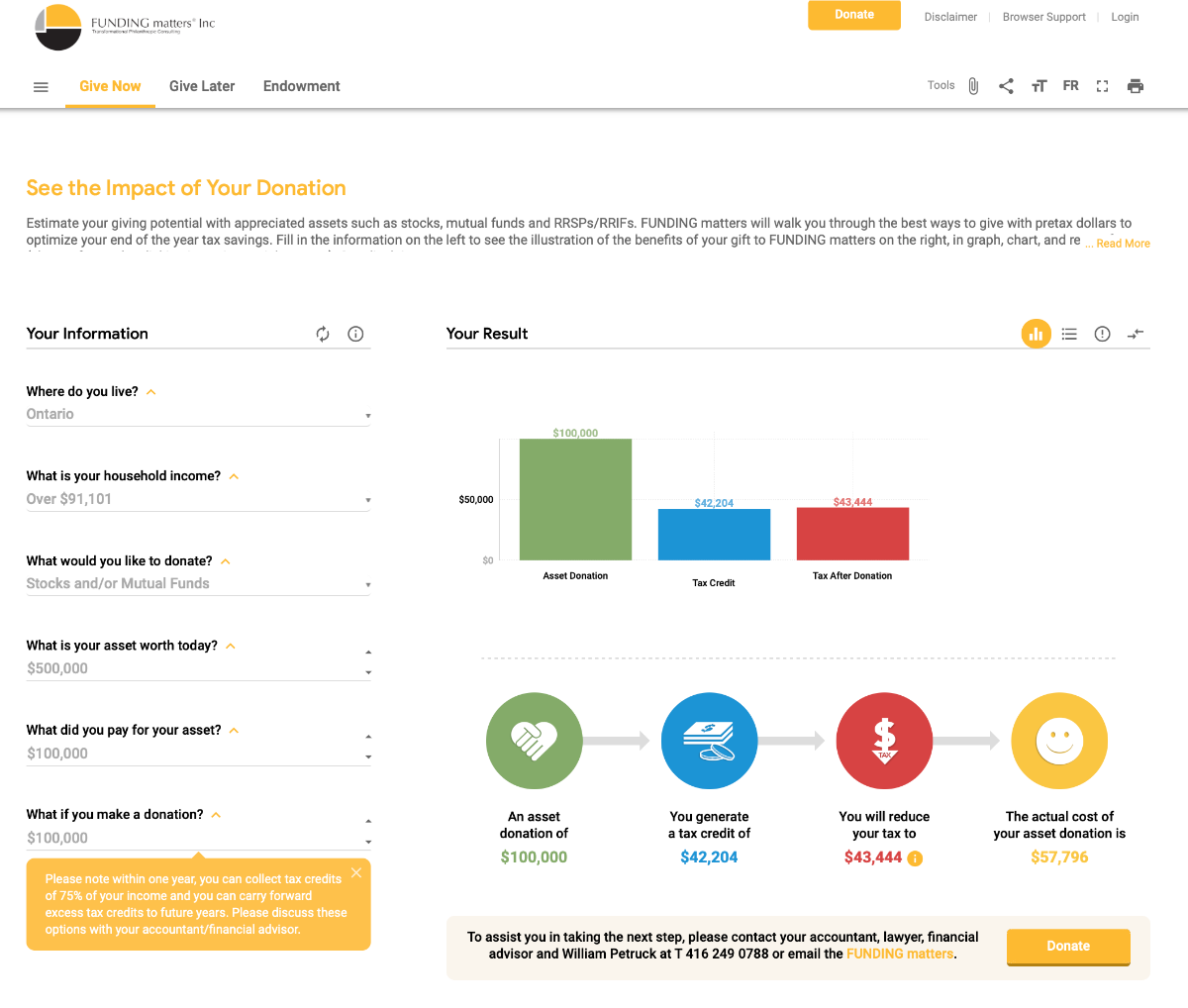
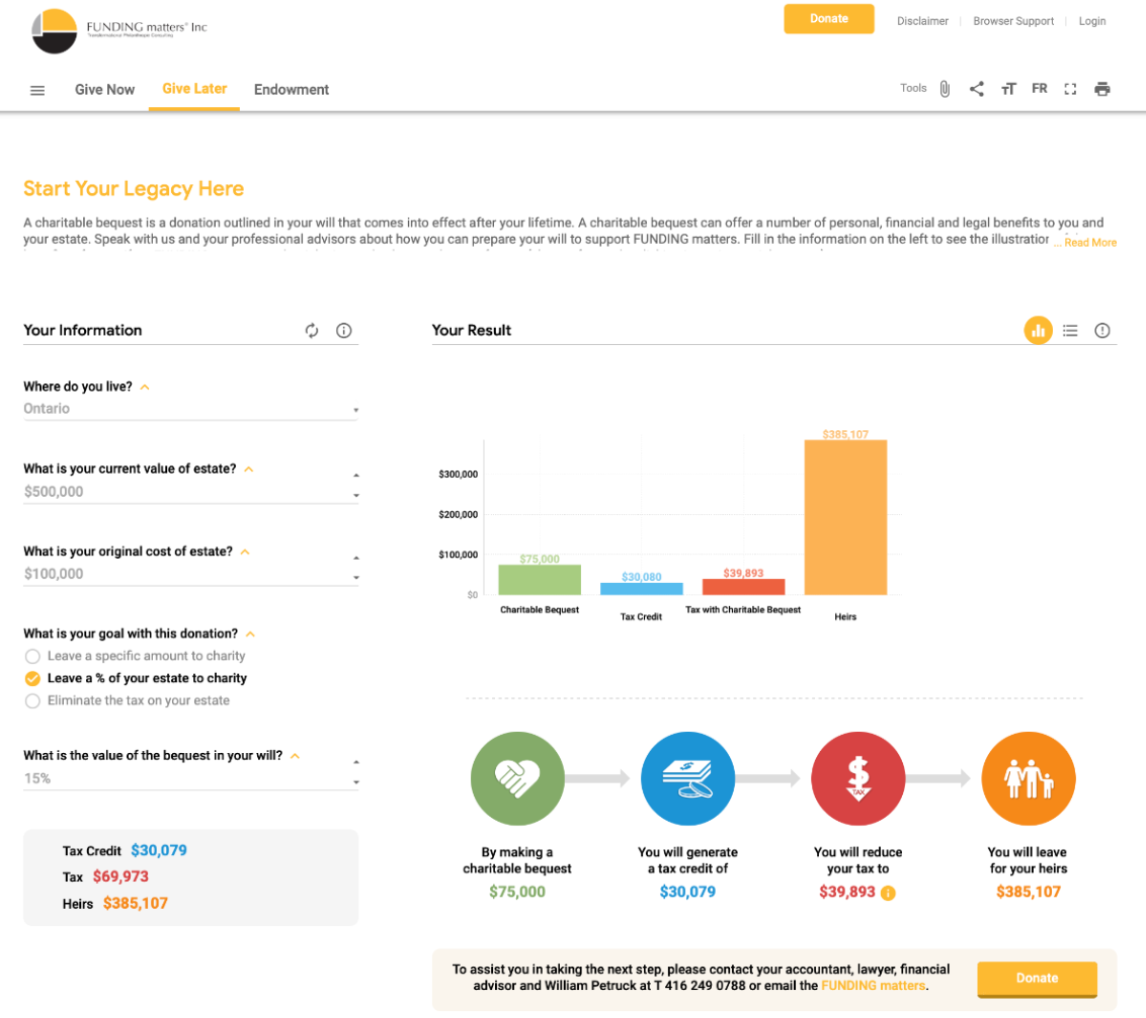
Tools such as donation calculators illustrate important insights and provide vehicles that engage your donors, with their families and their advisors. Be part of the solution and take the opportunity demonstrating how they can revisit their financial and estate planning this year and create philanthropic donations through tax efficient giving, bringing you one step closer to increasing your annual fundraising.

Give Now
A structured $100,000 donation from stocks or mutual funds from a $400,000 taxable capital gain.

Give Later
15% bequest or $75,000 donation from a $500,000 estate. Heirs receive $385,107.

The time to improve how you communicate with your community is now. Refreshing your website creating memorable micro-sites that address your current activities and illustrating strategies how your audience can see current and future giving scenarios. Sharing this information with your members will reinforce and strengthen your relationships and provide insights into what’s transpiring in your world.

I would love to hear your thoughts or send me an email to learn more!

2021 New Year Resolution

As we have embarked on 2021, many have decided to make a new year’s resolution, one for sure is to forget about 2020!

Many resolutions for individuals look at their financial planning for the year ahead. One aspect of financial planning can and should be philanthropic planning. Major gifts and estate plans can be discussed and presented to your donors as a viable option. This type of donation is a necessary addition to your fundraising.

Just like practicing the piano for 15 minutes every day, practicing your approaches with donors about their philanthropy can and should be an enjoyable and achievable objective. The pursuit for these types of donations will improve your fundraising outcomes in support of your programs and operations.

Implementing tools such as GIFTabulator (www.giftabulator.com) and incorporating expert advisors will help you and your donors understand the benefits associated with making a donation from assets, now or later.

Partnering with financial advisors who express a willingness to take part in the donor discussion will advance the donors comfort level and bring all closer to making a donation that will transform your organization. The combination of tools and expert knowledge will lead to your success!

In your donor outreach, let me suggest a few estate planning to-do’s that shouldn’t be ignored as we are in the early days of 2021…

Update your Will. Since 60% of individuals do not have a current will, it may be time for you to update yours.

Make a List of your tangible personal property assets. Take the time to figure out who gets what. Believe it or not it’s not the money or the real estate that your kids will fight over but your tea set, your baseball card collection or that special piece of jewellery. Creating a list of who gets what will help minimize any sort of strife.

Take a look at your RRSP or RRIF Beneficiary Designations. Make sure the people you want as your beneficiaries are correctly stated on your registered investments. This might be also a good time to discuss charitable giving options from you RRSP/RRIF now or in your estate plan.

See how your estate and philanthropic plans can be realized by speaking with your charity, financial, tax or legal advisors.

If you haven’t had a chance to take care of these matters, try your best to do so.

Have a Happy and Healthy 2021!

(Re)Building A Better World Through Philanthropy

(Re)Building A Better World for All through Philanthropy

Reflecting on the Past Week: George Floyd and the Tireless Ongoing Efforts in the COVID-19 Fight

For the last 30 years, I’ve had the opportunity to get to know so many of you. While we share a common interest in philanthropy to build better health care, education, social services, culture, art, recreation, just to name a few; I believe what we really share is a common interest in building a better future.

For George Floyd a better future was stolen. For the millions he represents, a better future feels constantly under attack.

This past week has played over and over in my mind the sacrifices of front line health care workers, the public service and those in retail and food service over the past three months in tending to the needs of those suffering or social distancing from COVID-19.  This week was also marked by individuals who have risen in solidarity to voice their concerns about justice, equality and prejudice.  I was touched in particular seeing police officers, joining in the marches and taking a knee.  The images are moving, poignant and unfortunate that a life was taken too early and under unjust circumstances.

Philanthropy has always been a cornerstone of positive change in our communities.  

At FUNDING matters inc. our mission is To Help Not for Profit Organizations Build A Better World (for All) Through Philanthropy 

This past week our mission has been playing over and over in my mind.

“For all.” Not for the few. Not just for the privileged, like me.

In ways big or small, we can and must make a difference. As a member of our philanthropy community, you are an influencer. Your influence may be over one or it may be of thousands, but we must all do our part.

We must commit to giving a voice to the voiceless, to investing in our communities and building tools that empower the powerless, to lending our resources to the oppressed, to standing up for our neighbors, to creating real opportunity for all.  We must all become better at listening, learning and changing for the better.

As you go about your week check in with your friends and colleagues. Be an ally. Ask how to help. Take the initiative to have uncomfortable conversations. Listen.

If you have ideas for what we can do, hit reply and let me know.

It is moments like these that define who we are as individuals and who we are as a collective.

I implore you to lean in and join us in the commitment to building a better future for all.


Stay calm, stay safe and be well.

Show Your Philanthropic Power. Find Out More.