

From Spare Change to Real Change:
Enlightened Philanthropy and How to Achieve It For All
In the previous blog, Why Visualization is the Key to Success, we talked about the importance of visualization to help donors, their families, and their advisors construct major and or planned gifts. This blog will continue the conversation, specifically focusing on how this visualization method pertains to stocks.
Here’s what you should know.
Option 1: Stocks and Mutual Funds
As briefly discussed in our last blog, the GIFTABULATOR is the best tool to use when helping illustrate estate, financial and philanthropic planning. It helps you minimize taxes while making the world a better place through planned or major gifts.
And — believe it or not — cash is not always king in the world of philanthropy. While many donors choose to donate using cash, it isn’t always the right move. What often happens is that donors will sell stocks in order to give a tax donation. Unfortunately, selling appreciated assets leaves the donor with the responsibility of paying capital gains tax.
Instead, they could select to gift their stocks to their charity of choice. This gives the donor a tax reduction and helps them avoid paying a capital gains tax in the process. Additionally, depending on the size and type of their gift, it could also lead to a reduction in their taxable estate.
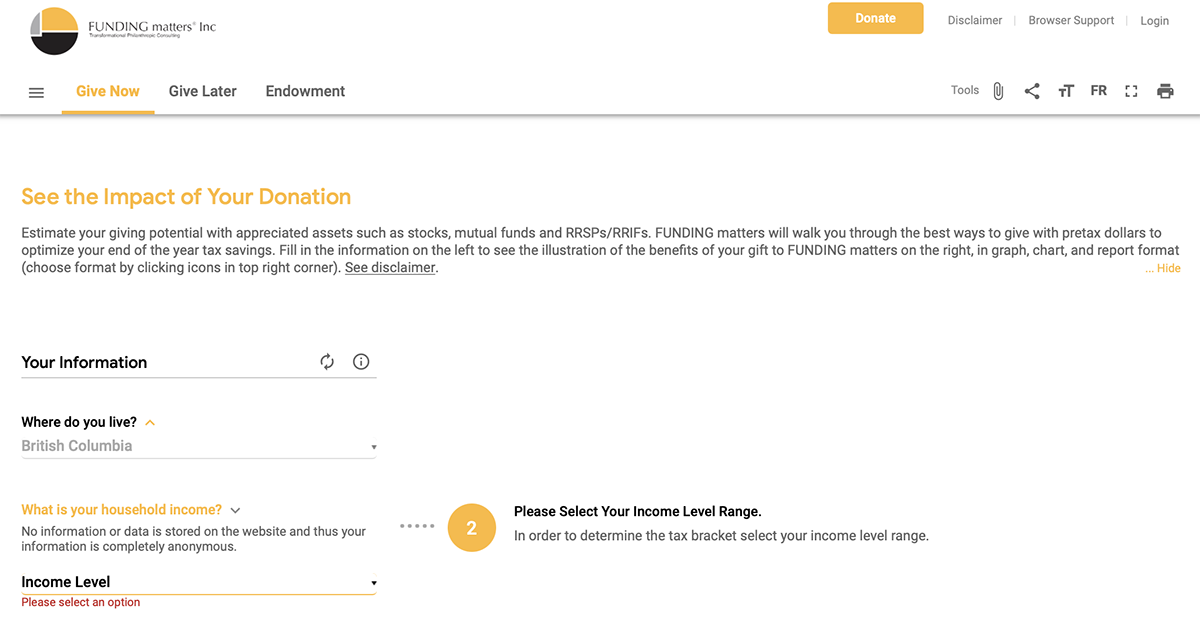
Calculating a Tax-Efficient donation is really easy when it can be visualized. First select the Province you live in. Let’s select British Columbia for our example.
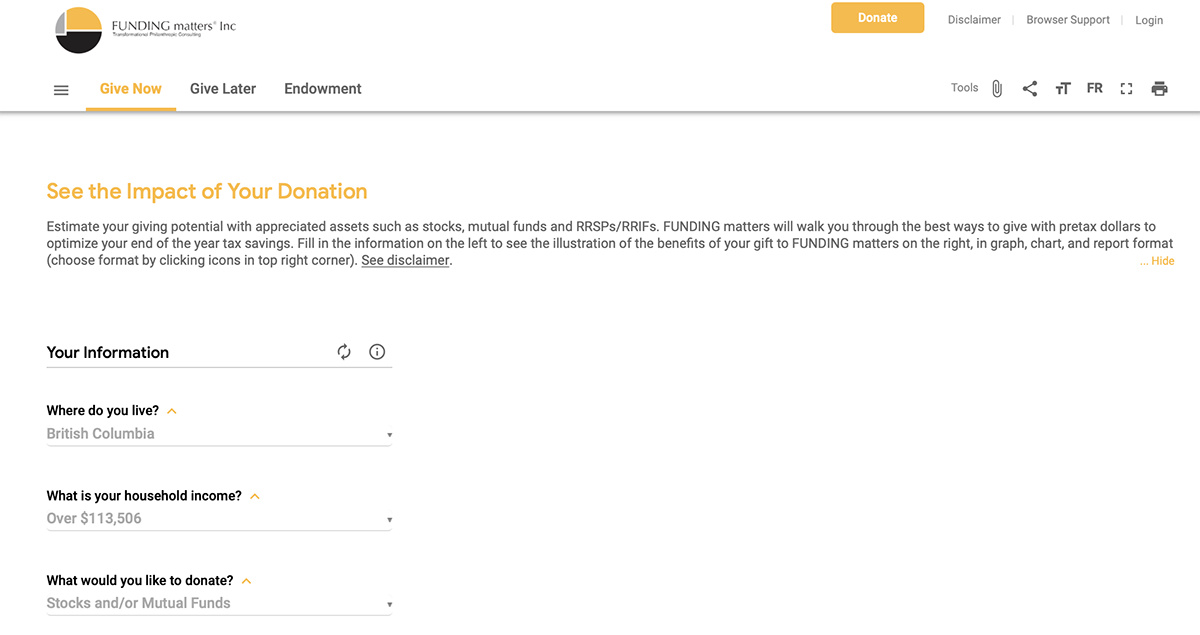
Then you’ll be prompted to select an asset. For this blog select Stock. You will see that the current value of the asset is $100,000. Feel free to change the asset to any amount.
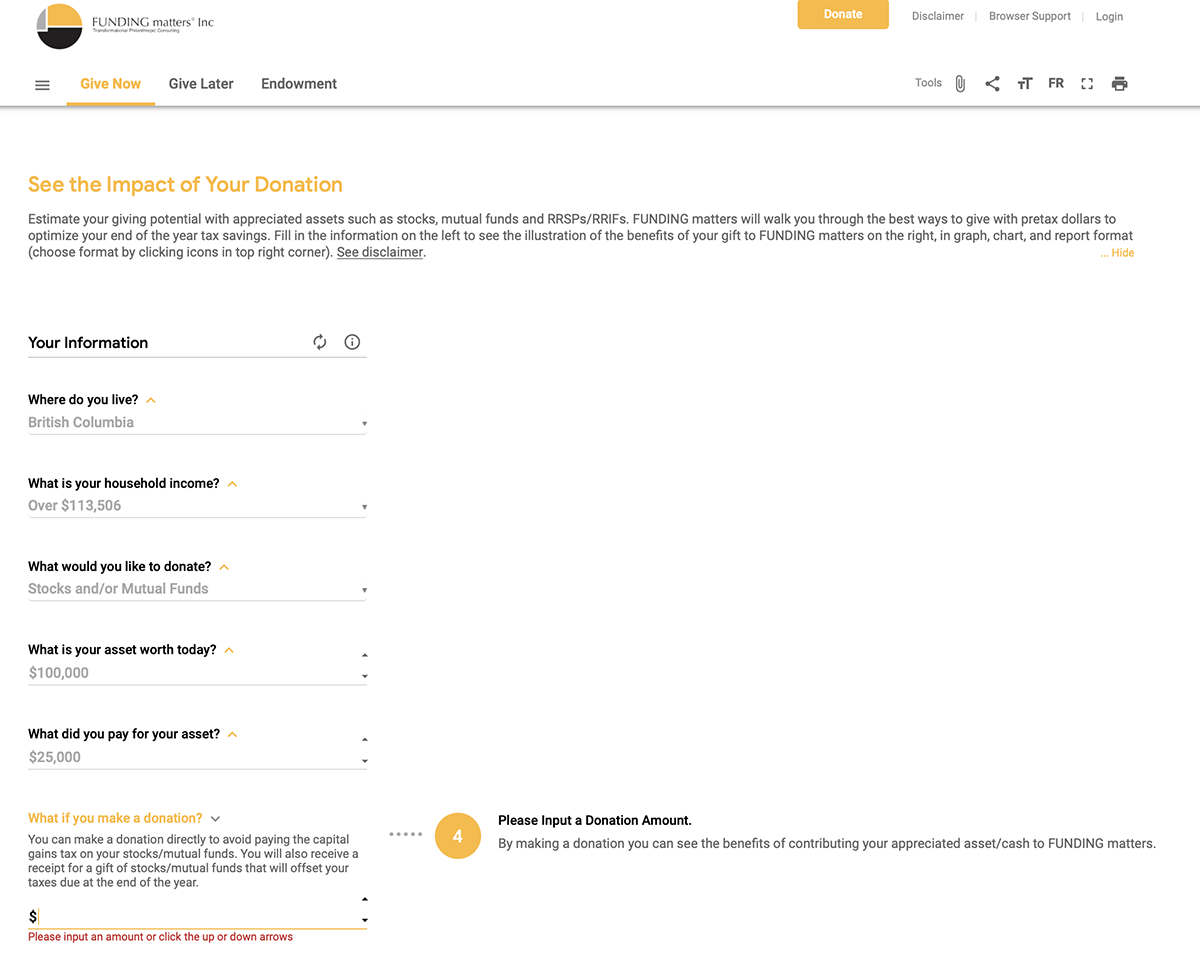
Giftabulator will then have the amount that you paid for your asset that is now worth $100,000. Populated into the app is amount suggesting you paid $25,000. You have a taxable capital gain of $75,000. $100,000 – $25,000. That math was simple. Now with the information you have input Giftabulator will calculate how much tax you owe on your capital gain if sold.
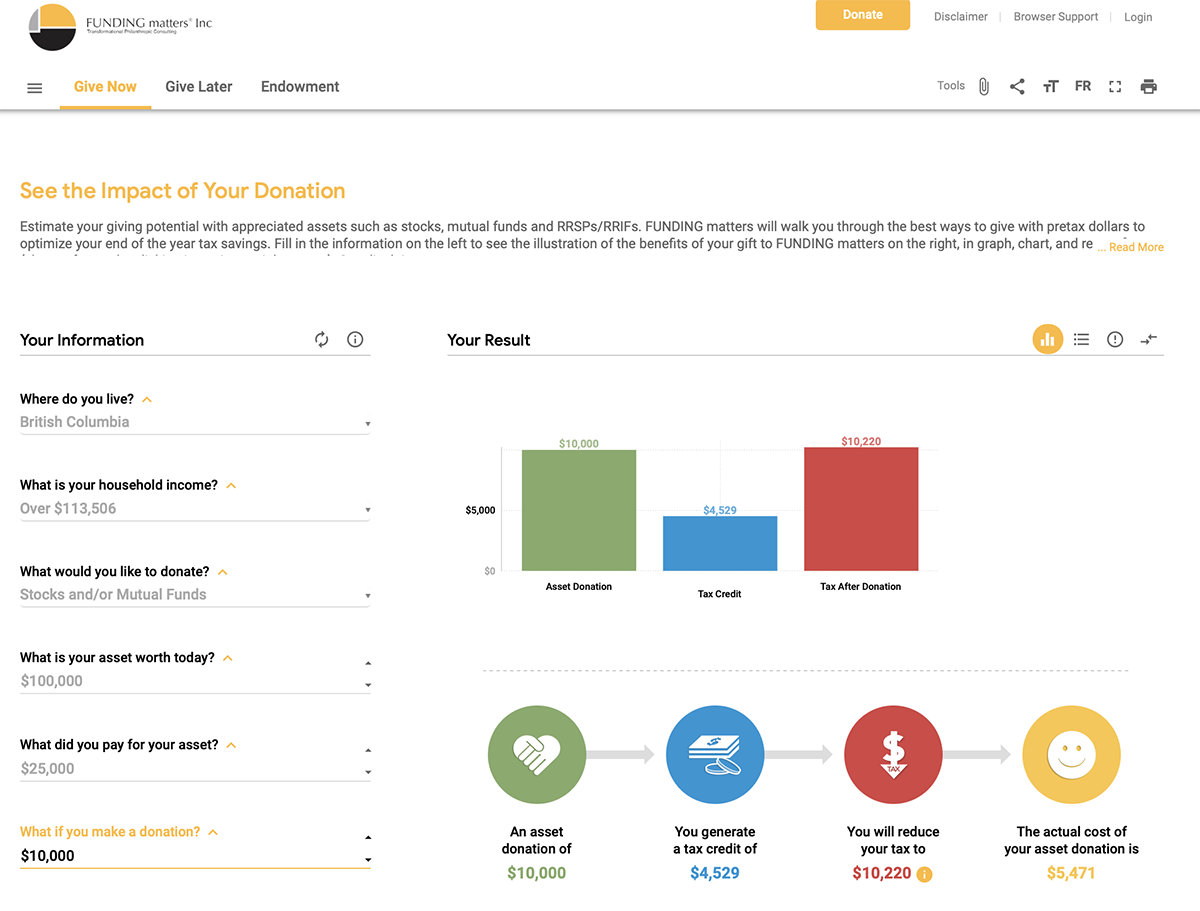
By inputting a donation amount of $10,000 you will see on the coloured charts your $10,000 donation which is illustrated in green. As well, you will see your tax credit from your $10,000 donation of $4,529 in blue. The red chart represents the tax you will owe from your $75,000 taxable capital gain. With your $10,000 donation your taxable capital gain has been reduced from $14,749 to $10,220. Finally, the actual cost of your $10,000 donation is illustrated in gold as $5,471.
Including Every Donor in the Conversation
Recently, we came across the article Making the Most of Mid-Level Donors. The authors, Sarah DiJulio and Yoonhyung Lee, state, “Mid-level donors are often overlooked at non-profits, even though they are among the most generous and loyal supporters and may have the potential to give much more if they are treated well. How can your organization attract, keep, and inspire mid-level donors to give more?”
The reality is that these mid-level donors are the backbone of your organization’s annual funding. The issue is how to convert many of these donors into major gift and planned giving donors. The key is to provide the tools that can illustrate the benefits associated with a larger donation and indicate where the funding can be sourced. Since most donors give from the “wallet” in the form of a credit card, cheque or cash, the ideal major gift should be sourced from appreciated assets with a taxable capital gain.
Why is this important for your donors to know? Illustrating a donation from an appreciated asset with a taxable gain will help the donor understand the benefit associated with a donation on which they will be paying tax if not used partially or wholly as a charitable gift. After all, no one wants to pay tax, and you’re providing them a fulfilling alternative through a donation to your organization!
Final thoughts
Over the next several weeks, we’ll be discussing all of the ways that potential donors can give to your organization. In fact, so many may not know that the money that they have in stocks can become a charitable gift. That “spare change” they have lying around can create real change — especially if you include every donor in the conversation!